
With supporters from across the globe beginning to travel to North America for the 2026 FIFA World Cup, health authorities in the United States, Canada and Mexico are stepping up efforts to prevent the spread of Ebola following a growing outbreak in East Africa.
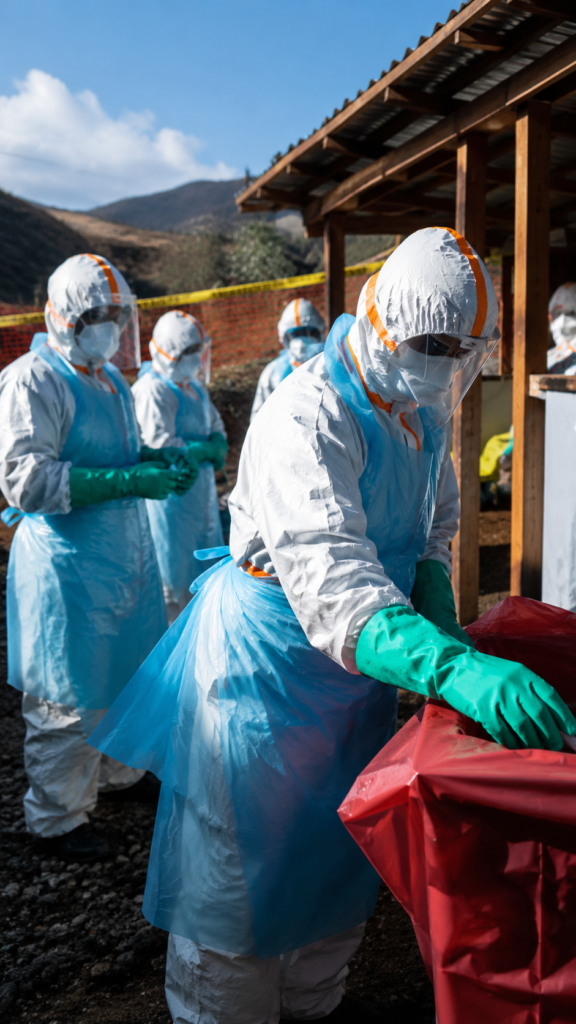
The outbreak involves the rare Bundibugyo strain of Ebola and was first reported in the Democratic Republic of the Congo (DRC) on May 15. Since then, at least 488 infections and 86 deaths have been recorded. The virus has also crossed into neighboring Uganda, prompting the World Health Organization (WHO) to classify the situation as a “public health emergency of international concern.”
Ugandan officials have reported 19 confirmed cases and two deaths. In response, the country has significantly restricted movement across its western border with the DRC, a decision that has affected regional trade and cross-border business activity.
The US Centers for Disease Control and Prevention (CDC) has warned that the outbreak could potentially become the largest Ebola crisis ever recorded, surpassing even the devastating West African epidemic of 2014–2016.
As more than one million football fans are expected to visit North America during the tournament, host nations have introduced a range of health measures aimed at reducing the risk of transmission.
New Entry Restrictions Introduced
The governments of the United States, Canada and Mexico announced coordinated travel policies targeting individuals arriving from African regions considered to be at the highest risk for Ebola exposure.
While officials did not disclose every detail of the joint approach, each country has implemented its own restrictions.
The United States introduced a ban in May preventing non-citizens who had recently visited the DRC, Uganda or South Sudan within the previous 21 days from entering the country. The policy was later expanded to include green card holders who had traveled to those nations during the same period.
Several major American airports, including Washington Dulles and Hartsfield-Jackson Atlanta International Airport, have also adopted enhanced health screening procedures for travelers arriving from affected areas.
Canada’s public health agency announced a temporary 90-day entry ban for residents of the DRC, Uganda and South Sudan.
Meanwhile, Canadian citizens, permanent residents and other eligible travelers returning from affected regions without symptoms must complete a 21-day quarantine period. The measure took effect on May 30.
Mexico has strengthened airport screening procedures and advised citizens to avoid nonessential travel to the DRC. Travelers arriving from the country are also being asked to follow a 21-day quarantine period.
DR Congo Team Forced to Train Abroad
The Democratic Republic of the Congo, appearing at its first World Cup since 1974, has seen its tournament preparations heavily impacted by the outbreak.
The team abandoned plans for a pre-World Cup training camp on home soil and instead established its base in Belgium.
Andrew Giuliani, executive director of the White House World Cup Task Force, told ESPN on May 23 that members of the Congolese delegation would need to remain in an isolated bubble environment in Belgium for 21 days. Failure to do so could result in denial of entry to the United States.
The team also lost a scheduled warm-up match against Chile in Spain after local authorities expressed concerns about the potential spread of Ebola.
Juan Franco, mayor of La Linea de la Concepcion in southern Spain, confirmed that he had signed a decree preventing the June 9 fixture from taking place.
DR Congo coach Sebastien Desabre suggested the game could be played behind closed doors but emphasized that his squad would adapt regardless of the circumstances.
“We are accustomed to adapting,” Desabre said. “Whatever happens, we will find a way to adjust.”
During the World Cup, DR Congo plans to establish its tournament base in Houston, Texas. Their opening Group K match is scheduled for June 17 against Portugal.
They will then face Colombia on June 24 in Guadalajara, Mexico, before concluding the group stage against Uzbekistan on June 28 in Atlanta, Georgia.
Disease Monitoring During the Tournament
Health organizations are also preparing extensive monitoring efforts throughout the competition.
Boston University’s Center on Emerging Infectious Diseases will track potential outbreaks through its BEACON program, which is designed to provide rapid information to public health authorities and tournament stakeholders.
According to the organization, the initiative aims to keep officials, participants and communities informed while identifying potential health threats as quickly as possible.
The National Special Pathogen System (NSPS) has also carried out preparedness exercises in anticipation of possible health emergencies during the World Cup.
One recent simulation focused on a hypothetical outbreak of Middle East Respiratory Syndrome (MERS) occurring during the tournament. Officials said the exercise demonstrated the importance of rapid response, coordination and detailed planning.
Experts Say Risk to Fans Remains Low
Despite the heightened precautions, public health specialists say the threat to ordinary fans attending the tournament remains minimal.
Oliver Johnson, a global health expert at King’s College London, told Reuters that Ebola transmission in high-income countries has historically been extremely limited.
“If you are attending the World Cup as a regular visitor, the risk of contracting Ebola is very low,” Johnson said.
He noted that Ebola is not an airborne disease and generally requires direct contact with someone who is seriously ill. Strong healthcare systems and effective contact tracing also help prevent wider spread when isolated cases occur.
Johnson added that any cases detected in developed countries are typically identified quickly and contained before significant transmission can occur.
Health experts continue to recommend basic precautions for travelers, including frequent hand washing, maintaining good hygiene practices and avoiding close contact with others when experiencing symptoms of illness.
As the largest World Cup in history approaches, authorities across North America remain focused on balancing public safety with the arrival of millions of football supporters from around the world.





Leave a Reply