
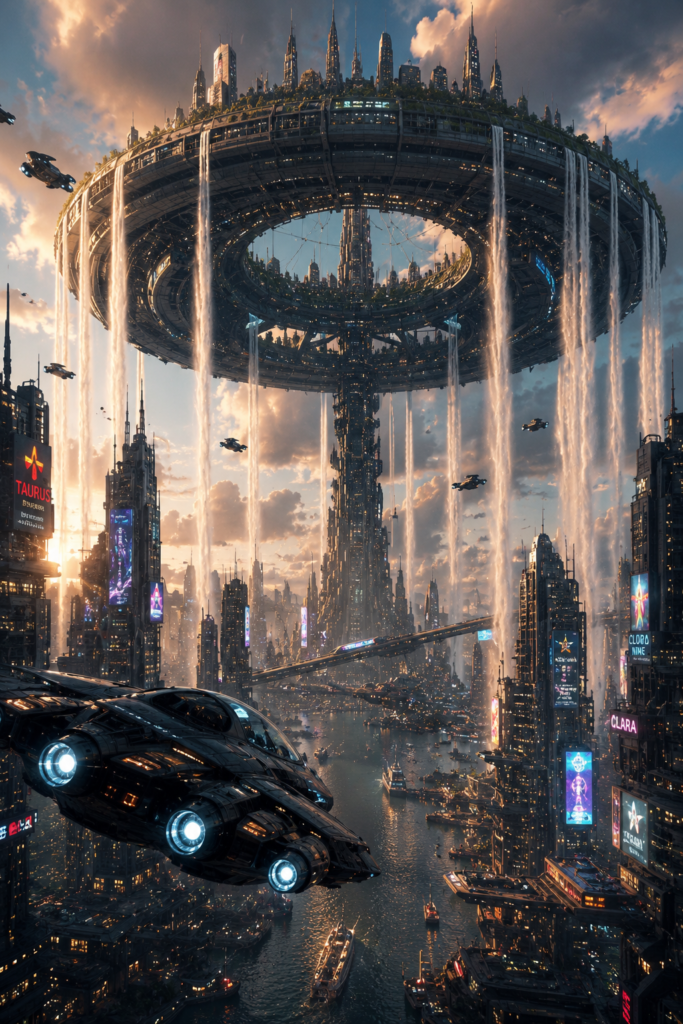
Imagine looking up into the sky and seeing an entire city suspended above the skyline.
Towering skyscrapers stretch toward the clouds. Flying vehicles move through organized air traffic lanes. Massive waterfalls pour from a gigantic floating structure high above the city, sending mist and light across the urban landscape below.
While this incredible scene exists only as a work of futuristic digital art, it has sparked widespread interest online as people debate what future cities might actually look like in the centuries ahead.
The image presents a vision of a world where technology has transformed nearly every aspect of daily life. Traditional roads have largely been replaced by aerial transportation systems, allowing vehicles to move freely through the sky. Buildings reach heights once thought impossible, while advanced engineering supports enormous structures suspended above the city itself.
For many viewers, the most fascinating feature is the massive floating ring dominating the skyline.
Some imagine it as a futuristic transportation hub connecting different parts of the city. Others believe it could serve as a self-sustaining residential district, powered by renewable energy and advanced water recycling systems.
The giant waterfalls have also become a major topic of discussion.
Could future engineers one day create artificial ecosystems suspended above cities? Could floating structures collect moisture from the atmosphere and distribute water throughout urban environments? While these concepts remain firmly in the realm of speculation, advances in engineering and architecture continue to push the boundaries of what was once considered impossible.
Urban planners have long predicted that future cities will look dramatically different from those of today. As populations continue growing and technology advances, many experts believe cities will become more vertical, more connected, and increasingly dependent on automation and artificial intelligence.
Flying vehicles remain one of the most popular futuristic concepts. Although fully developed flying-car networks do not yet exist, several companies around the world are already testing electric air taxis and advanced aerial transportation systems. Supporters believe these technologies could eventually reduce traffic congestion and revolutionize urban travel.
The popularity of futuristic city concepts reflects humanity’s long-standing fascination with the future. From early science-fiction novels to modern films and digital artwork, people have always imagined how technology might reshape civilization.
What makes this particular vision so compelling is its balance between realism and imagination.
The architecture feels believable. The transportation systems appear organized. Even the floating structures seem engineered rather than magical. As a result, viewers find themselves wondering whether some version of this future could actually become reality one day.
Social media users have shared countless theories about life in such a city. How would people travel? Where would they live? How would governments manage air traffic? What new jobs and industries would emerge?
While no one can predict exactly what future cities will look like, images like this encourage people to think beyond the limitations of the present.
Perhaps that is why futuristic artwork continues to capture attention around the world.
It offers more than entertainment.
It offers a glimpse into possibilities.
And whether that future arrives in fifty years, one hundred years, or never at all, the dream of a city floating among the clouds continues to inspire millions of people to imagine what comes next.





Leave a Reply